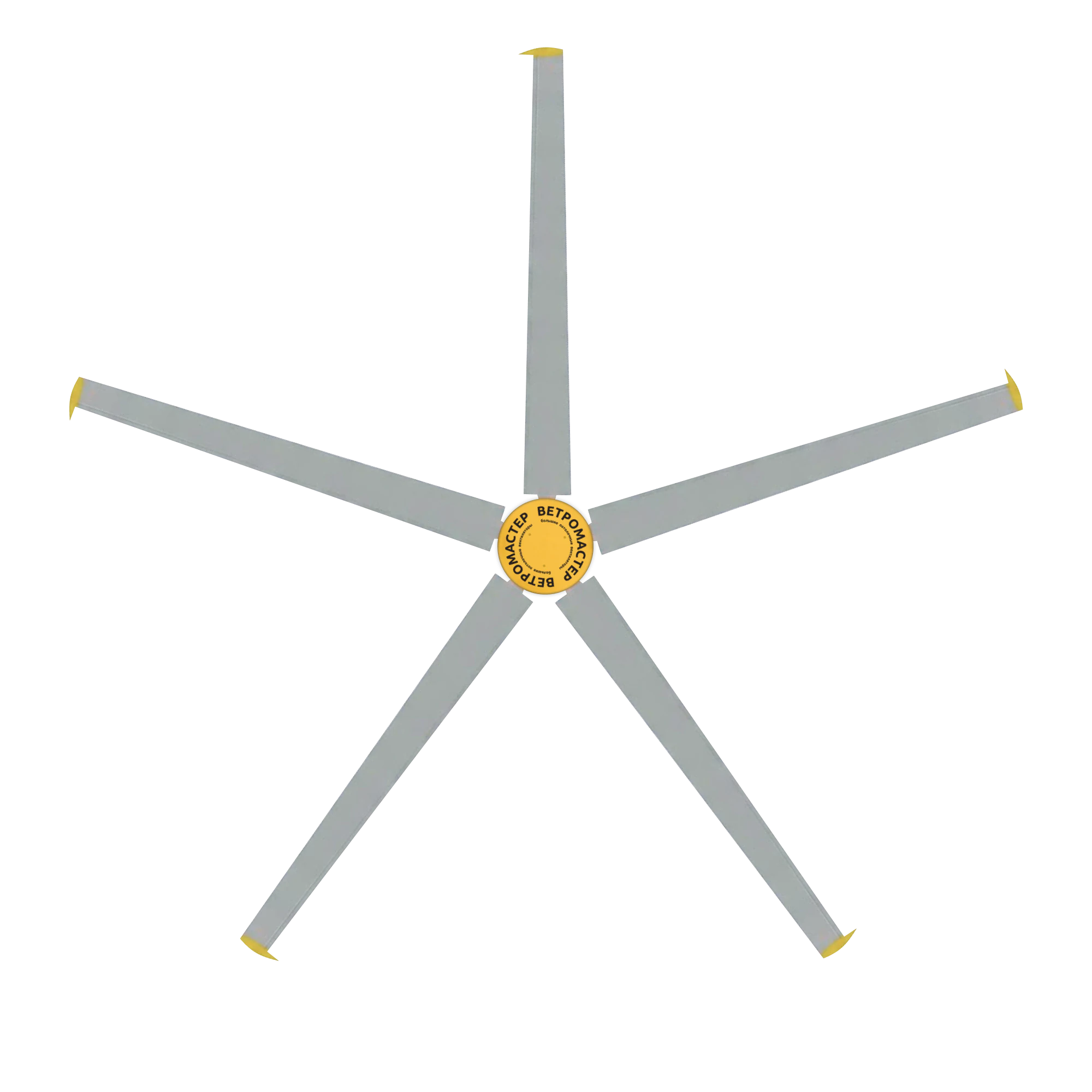
HVLS means High Volume, Low Speed. Instead of a sharp local draught, an HVLS fan moves a large volume of air gently through a large space.
Questions and answers
Concise answers about fan selection, applications, installation, operation and the VETROMASTER test drive
Basics and selection
No. It complements the existing climate system by distributing cooled or supply air, reducing stagnant zones and evening out conditions across the space.
Selection depends on floor area, ceiling height, occupied zones, existing ventilation, required airflow direction and whether ceiling, wall or mobile installation is possible. Share the facility parameters with our engineer for an accurate recommendation.
Product series
The M-700 Series consists of 5–7 metre industrial ceiling fans for large spaces with high ceilings, including factories, warehouses, hangars and agricultural facilities.
The M-300 Series includes 2.1–3.0 metre ceiling fans for public and commercial spaces. It provides gentle air movement where visitors are present and low noise matters.
The M-400 suits local areas where airflow must be directed towards a workstation, service bay, sports zone or warehouse area. Wall mounting keeps floors and access routes clear.
The M-800 is designed for temporary or changing requirements where fixed installation is impractical: events, terraces, sports areas, exhibitions, warehouses and manufacturing sites.
Typical applications include agriculture, warehousing and logistics, manufacturing and automotive service, restaurants and retail, fitness clubs, public buildings and events.
Applications
Yes. Gentle air mixing returns warm air trapped near the ceiling to the occupied zone, reducing temperature stratification and helping the heating system work more effectively.
Continuous air movement in cowsheds, poultry houses and other livestock buildings helps reduce overheating, stuffiness and stagnant moisture. Fans operate alongside the facility ventilation system.
They reduce stagnant zones between racks and help balance temperatures vertically. In summer this lowers perceived heat; in winter it brings warm air down from the ceiling.
Use the M-700 for whole-space air mixing, the wall-mounted M-400 for directed airflow at workstations, and the mobile M-800 for temporary or moving hot zones.
Yes. They distribute air without a harsh local draught. The M-300 suits lower public spaces; the final model and layout depend on area, height and occupancy.
Yes. M-800 mobile units can provide directed air movement at concerts, weddings, sports events, summer terraces and other temporary or outdoor venues.
The design considers height and structure, access routes, racking, equipment, workplaces, power points and airflow direction. We offer full installation and installation supervision.
Project, operation and service
Consumption and noise depend on series and operating mode. Each product page lists the relevant power and noise data, so models should be compared individually.
Yes. Automation can be included in the project. Operating logic, sensors and controls are selected for the specific facility and process.
Maintenance depends on the model and environment. Direct-drive solutions have no gearbox, reducing friction, noise and servicing needs for that assembly.
The published catalogue specifies up to 5 years for M-300, M-400 and M-800, and up to 10 years for M-700. Delivery depends on model and stock and is confirmed with your quotation.
Yes. A 30-day test drive lets you evaluate the fan under real operating conditions with the existing ventilation or air-conditioning system before deciding on permanent installation.
Still looking for
your answer?
Contact us to discuss your facility and get a complete engineering answer.
Telephone
8 800 550-54-62Email
info@vetromaster.ru